
Moody's Ratings - Sustainable debt finds a niche in data centers
Sustainable debt in data center financing is nascent but growing. Despite power and water use concerns, data center designs can align with green finance principles, writes Moody’s Swami Venkataraman.
Swami Venkataraman, Associate Managing Director and Head of Sustainable Finance Assessments at Moody’s Ratings, 09 Lug 2026 - 10:01
Demand for data center capacity is rising: at least $3 trillion of related investments will be required to meet global needs over the next five years, according to Moody’s analysis. Capital expenditure has so far been financed through retained earnings from major technology companies and a range of debt instruments, including bank loans, bonds, project finance and private credit.
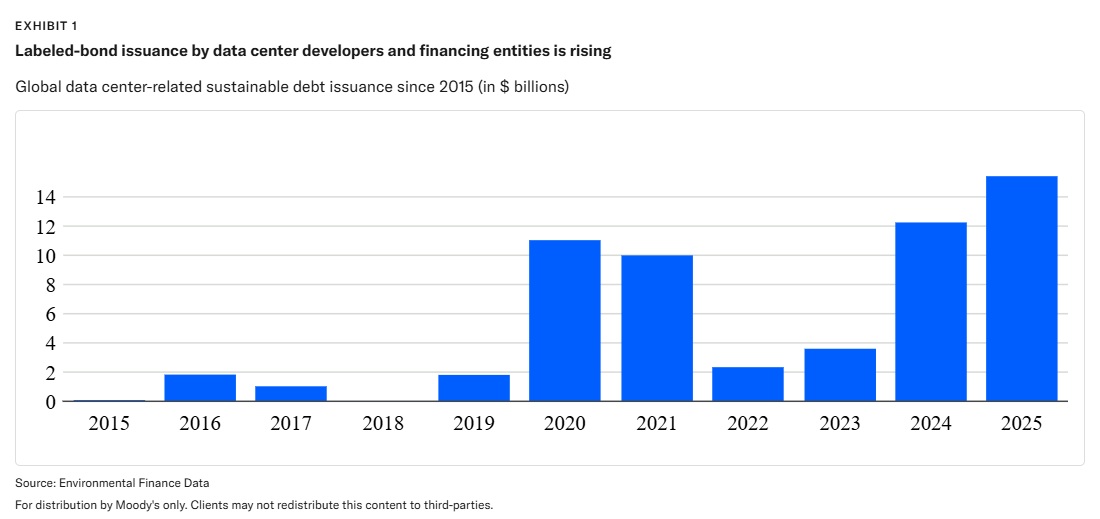
Sustainable debt issuance for data centers, has more than doubled since 2023 (see Exhibit 1). Issuance has been concentrated in North America, even as the broader labeled-bond market in the region has declined Moody’s expects more labeled-bond frameworks and instruments to include data center projects as issuers seek to broaden their investor base. That shift, however, has sharpened questions about data centers’ power and water demands. Local authorities are increasingly incorporating public concerns about higher electricity prices and the diversion of water resources into project approval decisions.
Moody’s second party opinions (SPOs) illustrate how some data center operators are aligning projects with achieving sustainability targets. Moody’s SPO assessment framework goes beyond alignment with principles to include a contribution to sustainability score, which ranks data centers' long-term sustainability credentials. Moody’s assesses financing frameworks' contribution to sustainability based on the relevance of the sustainability issues to the issuer, the regional context and the magnitude of their benefits.
Power efficiency is the near-term focus
Given the speed-to-market imperative and the shortage of baseload electricity across most markets, data center developers are typically securing any available power source.
Even developers that are managing emissions exposure are focusing first on power-use efficiency, while treating absolute emissions as a longer-term consideration. Power usage effectiveness (PUE), the ratio of a data center’s total energy consumption to the energy used by its IT equipment, remains the key operating metric. The worldwide average is around 1.54, according to the Uptime Institute Global Data Center Survey 2025, with values closer to 1 indicating more efficient energy use.
Local jurisdictions are progressively incorporating stringent energy and water efficiency requirements for new data centers: Germany, for example, will require new data centers to operate at a PUE of 1.2 or lower by 2026 and to incorporate at least 10% recycled energy.
Water scarcity is influencing cooling design
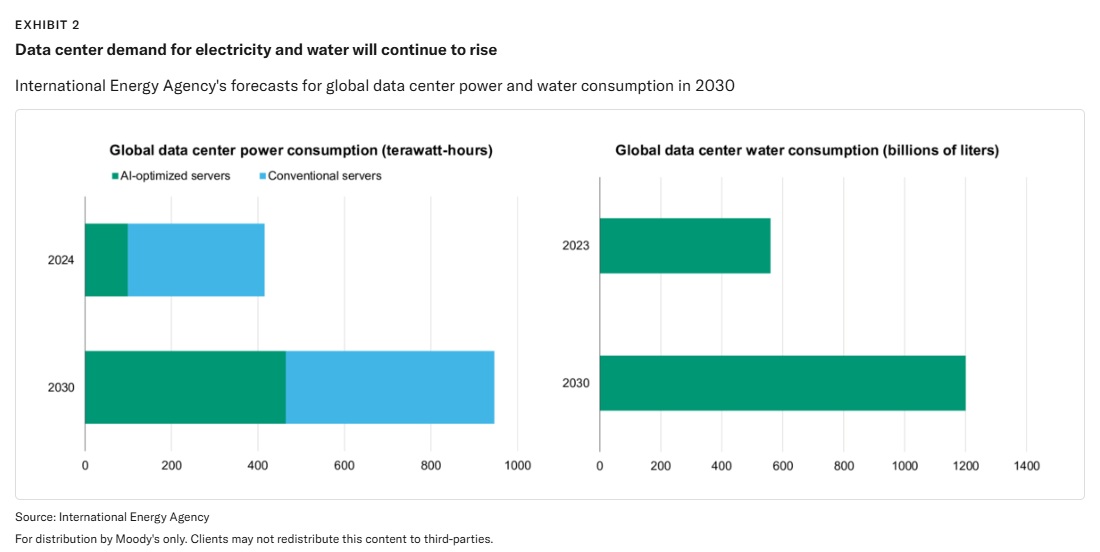
As global data center capacity expands, tension is rising between cooling needs and the availability of local water resources. Unlike power, which can travel long distances, water is inherently local, which makes siting decisions central to cooling design. Data center growth is intensifying competition for finite water supplies, especially in regions with high water stress. The International Energy Agency (IEA) expects global annual data center water consumption to grow to about 1.2 trillion liters annually by 2030 from 560 billion liters in 2024 (see Exhibit 2). On average, a 100-megawatt water-cooled hyperscale data center in the US uses about 2 million liters of water daily, comparable to the consumption of about 6,500 households.
Even so, a wide range of data center designs can still align with green bond principles and green loan principles, in Moody’s view. The reason is a basic trade-off between power and water use. Cooling choices reflect local climate, energy efficiency and water availability. Air-based and other advanced cooling technologies use little or no water, but they consume more electricity than water-cooled systems. Developers may therefore accept a higher PUE to build in a water-scarce region. Air-based cooling also faces greater constraints in warmer or more humid climates.
It is the sole responsibility of the Sustainable Network Member to check the truthfulness, accuracy and completeness of the data and information entered on this web page, when within its competence and provided by the Sustainable Network Member. Borsa Italiana S.p.A. is not responsible for the contents developed by third parties and in particular by the Sustainable Network Member contained in this web page.
Glossario finanziario
Hai dei dubbi su qualche definizione? Consulta il glossario finanziario di Borsa Italiana.