
Banco BPM -Transitions and Sustainable Development: A Call for Collective Action
Transitions shape our future. Technology, climate, energy, environment, demographics: Italy faces them all. Only collective action can turn challenges into resilience.
Raffaele Barteselli, Head of Transition and Sustainability, Banco BPM, 09 Lug 2026 - 10:05
The operating environment, structural transitions, and sustainable development have never been as inseparably intertwined as they are today. Geopolitical tensions are compounding the challenges of adapting to long-term trends already well underway — trends that demand early planning, strong determination, and indispensable collaboration among all economic actors, to prevent structural changes from becoming permanent constraints on future generations.
These “transitions” are shaping the economic development and well-being of our planet, people, and businesses. They move at different speeds and unfold in different ways — but one thing is certain: they are already reshaping our lifestyles and how we do business. The impact will be particularly significant in certain sectors and regions. Especially in Italy.
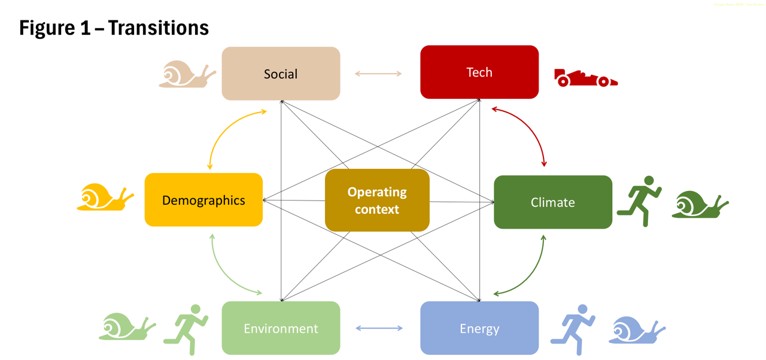
The fastest-moving is the technological transition. To remain competitive, businesses must invest in the best available technologies, digitalise processes, and defend against cyberthreats. In several key areas — microchips, advanced semiconductors, cloud infrastructure, AI — Italy is almost entirely dependent on foreign suppliers.
Closely behind is the climate transition, requiring action both to reduce emissions and adapt to their consequences. Italy is especially exposed: 70% of Europe’s annual landslides occur here, and its roughly 8,000 km of coastline face severe erosion and rising sea levels. In early 2026, several Italian regions have already suffered major damage from natural disasters.
Linked to this is the energy transition — shifting from fossil fuels toward renewables and diversifying supply. Italy’s heavy dependence on imported fossil fuels exposes it to sharp price swings, seriously undermining economic competitiveness. This feeds into the broader environmental transition, which seeks to restore ecosystem balance through reduced resource consumption, biodiversity protection, and circular economy principles. Italy’s land consumption rate (7%, peaking at 12% in Lombardy) is more than double the EU average, amplifying exposure to hydrogeological risks and biodiversity loss.
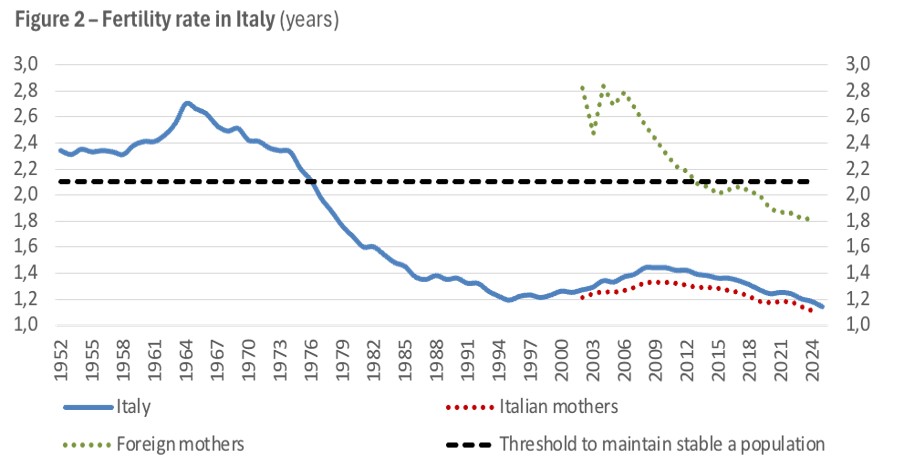
Finally, there is the demographic transition — perhaps the most consequential for Italy. The country’s median age (47.1) is the world’s highest after Japan, fertility has fallen to a historic low of 1.14, and without immigration the population by 2100 could be less than half of today’s. Within twenty years, over a third of Italians will be 65 or older, with a loss of 7 million working-age people. Rethinking the role of older generations in the workforce becomes essential: today just 5% of Italians aged 65+ remain economically active, versus 10% in Germany and 12.5% in Japan.
Adapting to all these transitions — and their interactions — is far from simple for any economic actor: not for businesses, especially smaller ones that form the backbone of Italy’s productive system, and not for banks, which must both adapt their own models and channel capital toward the most resilient companies.
To do so effectively, banks must evolve their assessment frameworks by integrating financial data with information on companies’ concrete adaptation efforts. That information can only come from the companies themselves. Without it, assessments rely on sector-level proxies that fail to capture actual performance.
Meeting these challenges requires a systemic response built on collaboration among all actors: public institutions, the financial system, businesses, and citizens. Only collective commitment, careful planning, and pragmatic action will allow future generations to live in a country that is, at last, more resilient, inclusive, and sustainable.
It is the sole responsibility of the Sustainable Network Member to check the truthfulness, accuracy and completeness of the data and information entered on this web page, when within its competence and provided by the Sustainable Network Member. Borsa Italiana S.p.A. is not responsible for the contents developed by third parties and in particular by the Sustainable Network Member contained in this web page.
Glossario finanziario
Hai dei dubbi su qualche definizione? Consulta il glossario finanziario di Borsa Italiana.